Which AI model is best for your own task? Our own test and a public leaderboard disagreed
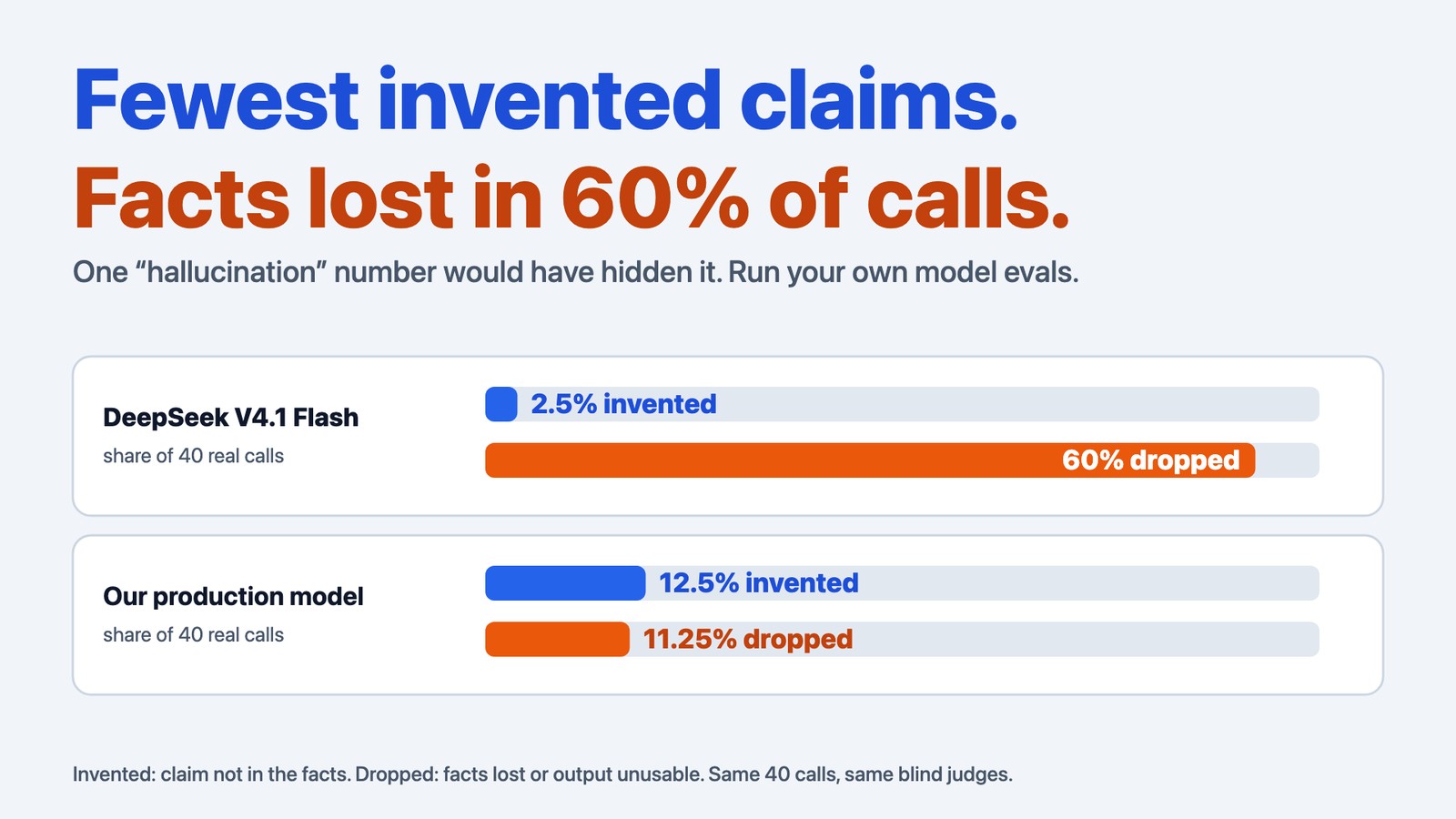
The one that does best on a test built from your own work. A public leaderboard can tell you which models to try, not which one wins on your job. We tested five models on 40 of our own production calls, with two blind AI judges in each round and the rules written down before any result came in. The calls to the models under test cost $1.53 across two rounds. A well-known public leaderboard ranked four of the models we tested, by name, in a very different order. The one with the best hallucination rate of the four on the leaderboard did no better than our production model at avoiding invented claims on our task, and it lost facts in nearly half of our calls. The one with the worst rate tied production. Neither ranking is wrong. They measure different skills, and this piece ends with a seven-step checklist for running the same kind of test on your own task.
The job we tested
Our AI agents share a long-term memory store. One of its jobs is consolidation: a language model receives stored facts and merges them into short summaries, which we call observations. In production that model is Xiaomi's MiMo-V2.6-Flash, with thinking (extra reasoning before it answers) set to medium. We wanted to know whether another model could do this job better, or as well for less.
A summary can go wrong in two ways, and we counted them apart:
- Invented: the summary states something the facts do not support.
- Dropped: the summary loses facts, or the output is invalid and cannot be used.
How we tested
- Real inputs, frozen. We took 40 real production calls and froze them. Every model received the same 40, in both rounds.
- Six setups in the first round. Production MiMo with thinking on and with thinking off, and four other models: MiniMax M3.1 Flash, Qwen3.8 27B, Claude Haiku 5.5 and DeepSeek V4.1 Flash. All ran at medium reasoning effort (how much the model thinks before answering), our production setting, except the thinking-off setup.
- Two blind judges in each round. Two Claude Opus judges scored every summary without knowing which model wrote it.
- Rules first. The pass and fail rules were written down before any result was seen. This is called pre-registration.
- Planted errors. We planted 12 known errors: 7 invented claims and 5 status errors, in which a fact's recorded status was flipped. Both judges caught all 12, which shows they could see invented claims. No plant tested dropped facts; the judges' agreement on those, below, is the only check there.
- Agreement measured. Judge agreement, as Cohen's kappa (0 is chance, 1 is perfect agreement), was 0.67 on invented claims and 0.80 on dropped facts.
What we found
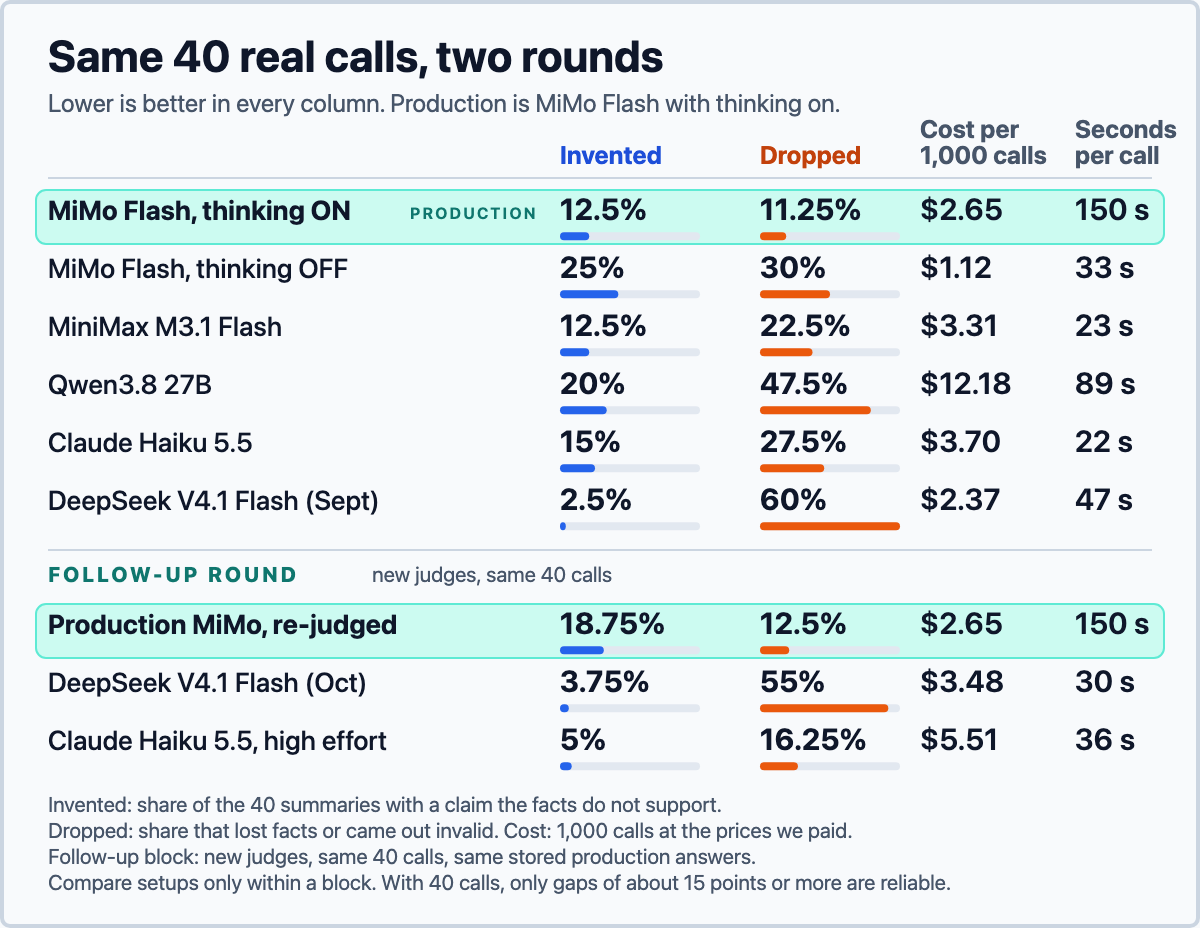
The same figures as text. First round, six setups:
| Setup | Invented | Dropped | Cost per 1,000 calls | Seconds per call |
|---|---|---|---|---|
| MiMo-V2.6-Flash, thinking on (production) | 12.5% | 11.25% | $2.65 | 150 |
| MiMo-V2.6-Flash, thinking off | 25% | 30% | $1.12 | 33 |
| MiniMax M3.1 Flash | 12.5% | 22.5% | $3.31 | 23 |
| Qwen3.8 27B | 20% | 47.5% | $12.18 | 89 |
| Claude Haiku 5.5 | 15% | 27.5% | $3.70 | 22 |
| DeepSeek V4.1 Flash (September snapshot) | 2.5% | 60% | $2.37 | 47 |
Follow-up round, new judges, same 40 calls and the same stored production answers:
| Setup | Invented | Dropped | Cost per 1,000 calls | Seconds per call |
|---|---|---|---|---|
| MiMo-V2.6-Flash, thinking on (production), re-judged | 18.75% | 12.5% | $2.65 | 150 |
| DeepSeek V4.1 Flash (October update) | 3.75% | 55% | $3.48 | 30 |
| Claude Haiku 5.5, high effort | 5% | 16.25% | $5.51 | 36 |
Invented and dropped are each the share of the 40 summaries with at least one such failure, averaged over the two judges, which is why some rates fall between whole calls: 11.25% is 4.5 of 40. Cost is what 1,000 calls cost at the prices we paid. The second table, and the lower block of the card, is the follow-up round, described further down; compare setups only within one round.
No candidate was clearly better under our rules, so production stays. Three findings matter more than that verdict, and one bug needs disclosing.
One number would have hidden the trade-off. DeepSeek V4.1 Flash invented the least of any setup in the first round: 2.5% of calls. It also dropped facts in 60% of calls. Pick a model on invented claims alone and you would choose it, then lose facts in six calls out of ten.
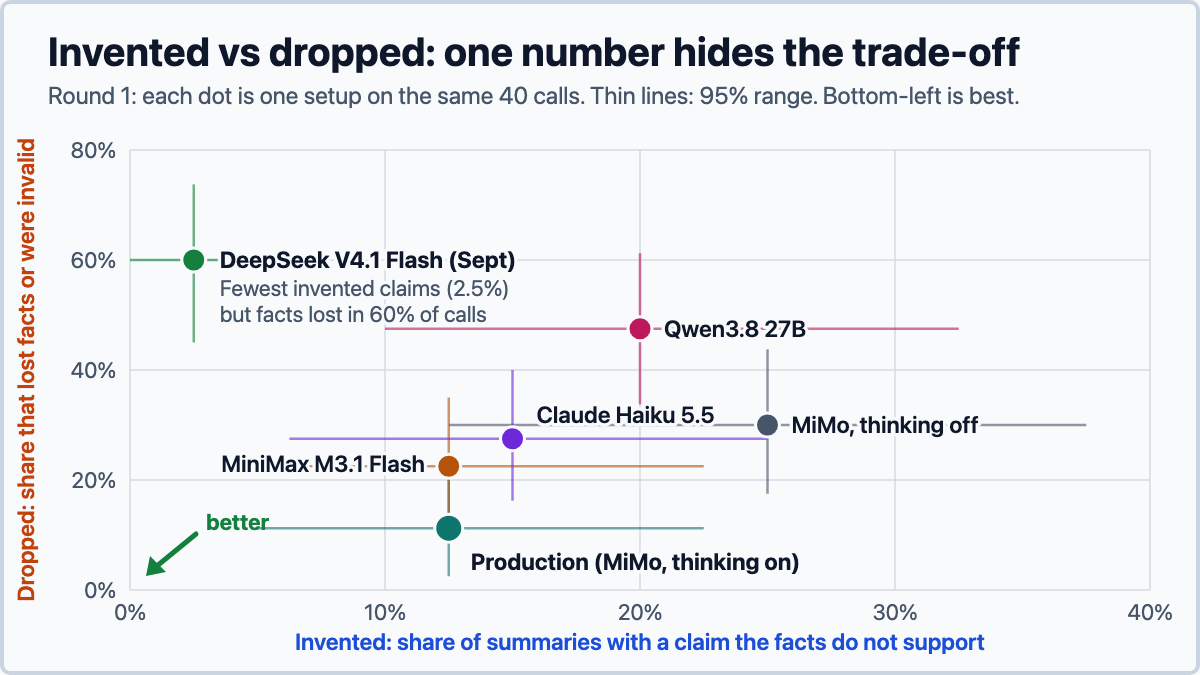
Turning thinking off is a real trade. With thinking off, MiMo was about 2.4 times cheaper per call and about 4.5 times faster. Its invented claims doubled, from 12.5% to 25%, and dropped facts rose from 11.25% to 30%.
Forty calls show only large gaps. Haiku invented claims in 15% of calls against production's 12.5%: inside the noise. Its dropped facts ran 16.25 points higher, and that gap is large enough to separate at this size: the 95% range of the paired difference, 3.75 to 28.75 points, stays above zero. The separate ranges drawn on the chart overlap; the paired range is the one that counts. At this size the test can detect differences of roughly 14 to 18 points, which our pre-registration stated before the run.
One bug, found after the results and disclosed. A scoring bug had swapped the two bounds of a confidence interval (the range a true value probably falls in). We fixed it, recorded the fix in the pre-registration and scored again. No recommendation changed: no candidate passed before the fix or after it. One label did change: before the fix, Qwen was marked clearly worse than production; after it, that gap was not separable at 40 calls.
Can you trust a public LLM leaderboard to pick a model for your product?
For a shortlist of models to try, yes. For the final pick, not on its own: the one we checked measured a different skill, on a different snapshot and different settings. Artificial Analysis publishes AA-Omniscience, a leaderboard built on 3,000 questions. We compared its scores with ours on 7 November 2026. Four of our models appear on it.
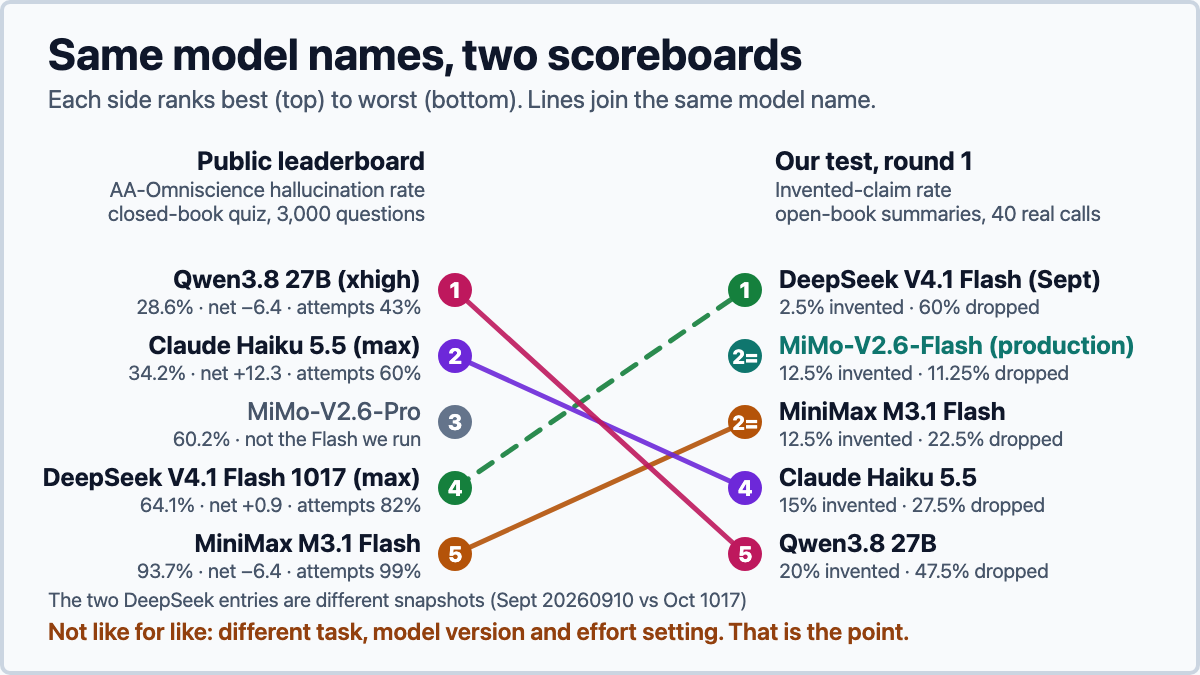
The dashed DeepSeek line on this chart joins two different snapshots of the model; reason 2 below explains why that matters.
On the leaderboard's net score, which runs from −100 to 100, Claude Haiku 5.5 comes first of the four, at +12.3. On our task it was no better than production at avoiding invented claims, and it dropped more facts. MiniMax M3.1 Flash has the worst hallucination rate of the four, 93.7%, yet on our task it tied production on invented claims, at 12.5%. Its score no longer appeared in the leaderboard page's data on 26 November 2026; our copy of 7 November is the source for it. Qwen3.8 27B has the best hallucination rate of the four, 28.6%; on our task it invented claims in 20% of calls and dropped facts in 47.5%.
There are four reasons, and each is worth checking on any leaderboard you use to pick a model.
1. The same word names a different skill. AA-Omniscience is a closed-book test: the model answers from its own memory. Its hallucination rate is the share of wrong answers among all the questions the model did not get right, declined ones included, so declining to answer lowers the rate. Qwen attempted 43% of the questions and has the best rate of the four. Our job is open-book: the facts are in the prompt, and declining is not an option.
2. The same name covers different versions. We called DeepSeek by its plain model name. That name pointed to a September 2026 snapshot (a dated release): the canonical id in the catalogue of the API service we called it through ends in 20260910. The leaderboard scored the 17 October update, "-1017". It shares the name family, and it is a different model. Record the exact snapshot you test.
3. The settings differ. The leaderboard ran Haiku and DeepSeek at maximum reasoning effort and Qwen at extra-high; we ran everything at medium. At the start of the follow-up round we tried Haiku at maximum on our task. Both test calls stopped at 65,536 output tokens, almost all of them spent on thinking, after about four minutes each, and neither returned an answer. We set no output limit; the endpoint that served the calls stopped there. Two calls are not a rate. They do show that a setting which tops a leaderboard may not finish your job on the endpoint you use.
4. Coverage has gaps. The leaderboard has no score for MiMo-V2.6-Flash, the model we run. It scores the Pro version, which is a different model. A missing score is no evidence either way.
None of this makes AA-Omniscience wrong. It measures what it says it measures: knowledge recalled from memory, and honest refusal. If your job is answering questions from memory, it is a good guide. Ours is not.
The follow-up round
Two fair questions were left. Did the DeepSeek version matter? Did Haiku need more effort? We ran two more setups on the same 40 calls: DeepSeek V4.1 Flash, the October update, at medium effort; and Claude Haiku 5.5 at high effort. Haiku at maximum had not finished its two test calls, so we moved it to high before any scored call and recorded the change in the pre-registration. Two new blind judges scored production's stored answers alongside the new ones. Their agreement was 0.70 on invented claims and 0.77 on dropped facts, and both caught all 12 errors in a fresh set of plants.
- DeepSeek, October update. Invented claims in 3.75% of calls, against production's 18.75% in this round: a gap of 15 points, with a 95% range of 3.75 to 27.5 points, and each judge on its own found the same 15-point gap. It dropped facts in 55% of calls, against production's 12.5%. That is the same trade-off as the September snapshot, so the newer version did not fix it. It ran about 5 times faster and cost about 30% more per call.
- Haiku, high effort. Invented claims in 5% of calls, against production's 18.75%, but the 95% range reaches zero, so 40 calls cannot separate it from production. Dropped facts were about level, 16.25% against 12.5%, and also not separable. It cost about twice as much per call and ran about 4 times faster. At high effort it finished all 40 calls.
No setup met our rules, and production stays. The follow-up closed the version gap for DeepSeek. The effort gap remains, since the leaderboard ran both models at maximum.
Judges drift. The same stored production answers were scored at 12.5% invented in the first round and 18.75% in the second: different judges, different packets, identical answers. Compare models only inside one round, scored by the same judges. Absolute rates from separate judging runs are not comparable, and the same caution applies to any leaderboard number set beside another.
What this test cannot tell you
It covers one task and 40 calls, judged in two rounds. The judges are Claude models and one candidate is a Claude model; blinding reduces that risk without removing it. We did not test every setting the leaderboard used: DeepSeek at maximum effort, for one. Read the result as strong evidence about our job and weak evidence about anything else.
How do you evaluate an LLM on your own task?
- Freeze real inputs. Take real calls from production, as many as you can afford, and give every model the same ones.
- Name each failure separately. Count each kind of failure on its own. Never blend them into one score.
- Write the rules first. Set the pass and fail rules before you see a single result.
- Pin the version and the settings. Record the exact snapshot, the reasoning effort and the temperature.
- Judge blind, with two judges. Hide the model names, report how often the judges agree, and compare models only within one judging run.
- Plant known errors. If the judges miss them, the scores mean nothing.
- Say what the test can detect. A small test finds only large gaps. Fix bugs in the open.
The calls to the models we tested cost $1.53 across both rounds, pilot calls included; the judges' own model calls are not in that figure, and neither is the work of building the test. A public benchmark can tell you which models are worth trying. Only a test on your own work can tell you which one to ship.